 Name Finder
 Browse Name List
 Random Names
 Danish Names
 Faroese Names
 Finnish Names
 Greenlandic Names
 Icelandic Names
 Norwegian Names
 Sami Names
 Swedish Names
 More Nordic Names
 Bibliography



Óðinn

Rate this name:


Usage
Origin and Meaning
1) Old Norse óðr = 'furious', 'eager', 'mad' [1] [2] [3] [4] [5] [6] [7]
2) Old Norse óðr = 'song', 'poetry' [1]
3) Celtic *ûātis = 'priest' [6] [7]
Related Names
| Óðin | ♂ |   |

|
| Odinn | ♂ |  |

|
| Oðinn | ♂ | |

|
| Óðinn | ♂ | |

|
See also Odhinn
Patronyms [What's That?]
Male
| Óðinsson |
|
Female
| Óðinsdóttir |
|
Combinations
For combinations see ODIN (name element)
Grammar
| - Icelandic |
|
|---|---|
| Nominative: | Óðinn |
| Accusative: | Óðin |
| Dative: | Óðni |
| Genitive: | Óðins |
Further Information
Place Names
The Danish place name Odense derives from Óðins Vi = 'Óðinn's Sanctuary'
Norse Mythology
Óðinn is the chief god of the Æsir in the Northern mythology, the god of wisdom, poetry, magic, runes, ecstasy and the god of the dead and of war. According to the Ynglingasaga, Óðinn is one of the first kings of the Ynglingar.
Óðinn and his brothers Vili and Vé are sons of the giants Burr and Bestla. With his brothers he created the first people Askr and Embla.
He lives in Ásgarðr in Hliðskjálf from where he can look over the whole world.
He acquires his knowledge from Mímir's head and by drinking from Mímir's well, but he had to sacrifice an eye in order to do so. [2] [3]
Óðinn's Children
- Baldr (by his wife Frigg)
- Bragi
- Heimdallr (by nine sisters)
- Hermóðr
- Hǫðr
- Sigi
- Skjǫldr
- Sæmingr
- Týr
- Váli/Vali (by Rindr)
- Vegdeg
- Víðarr
- Yngvi
- Þórr (by Jǫrð)
[2] [3] [4]
Óðinn's Attributes
- His spear Gungnir
- His ring Draupnir
- His ravens Huginn and Muninn
- His wolves Geri and Freki
- His eight-legged horse Sleipnir
- His hat
- His cloak
Óðinn's Names
- Akaz = 'Driving One'
- Aldafaðir/Alfaðir/Alfǫðr = 'Father of All'
- Aldagautr (?) = 'man-Gautr' (maybe only a scribal error; cf. Aldafaðir and Gautr
- Almáttki Áss = 'Almighty As'
- Arnhǫfði = 'Eagle-Head'
- Ásabragr = 'the best of the Æsir'
- Atríðr = 'attacker'
- Bifliði = 'the One who makes the armies quake'
- Biflindi = 'story shield'
- Bjǫrn = 'Bear'
- Blindi = 'Blind One'
- Brúni = 'Brown One' or 'the One with Bushy Eyebrows'
- Bǫlverkr = 'Evil-doer, Malefactor'
- Dresvarpr = 'spear thrower' (?)
- Dǫrruðr = 'spear warrior'
- Ennibrattr = 'Steep-Forehead'
- Fākaz = 'horse'
- Farmatýr = 'God of the Burden'
- Fengr = 'catcher'
- Fimbultýr = 'Mighty God'
- Fjǫlsviðr = 'He who knows much'
- Forni = 'Old One'
- Fundinn = 'Found One'
- Gagnráðr = 'He who advises against'
- Gangleri = 'He who is tired from walking'
- Gangráðr = 'He who knows the way'
- Gaupnir = 'He with the hollow hand'
- Gautr = 'Goth, from Gautland (= Götaland , Gothia in southern Sweden)'
- Ginnar = 'Deceiver'
- Glīaugiz = 'Shining eye'
- Grímnir = 'Masked One'
- Gǫllnir = 'Caretaker' or 'Hawk'
- Hangaguð = 'Hanging-God (god of the gallows)'
- Hangatýr = 'Hanging-God (god of the gallows)'
- Hangi = 'Hanging One'
- Hár = 'Blind One'
- Hárbarðr = 'Grey-Beard'
- Hárr = 'High One'
- Herfǫðr = 'father of the army'
- Hertýr = 'Army-God'
- Hjálmberi = 'Helmet-Bearer'
- Hnikarr, Hnikuðr = 'Instigator'
- Hrafnaguð = 'Raven-God'
- Hrafnblótr = 'Raven-Worshipper'
- Hrani = 'Brutal One'
- Jalkr = 'gelding'
- Kjalarr = 'Caring, Catering One'
- Míms vinr = 'Mímir's friend'
- Njótr = 'Enjoyer' (see NIUT)
- Óski = 'Wish'
- Síðhǫttr = 'Long Hat'
- Síðskeggr = 'Long Beard'
- Sigfaðir = 'Father of Victory'
- Siggautr = 'Victorious Goth'
- Sváfnir = 'Slayer'
- Svǫlnir = 'Cooler, Cooling One'
- Tveggi = 'Double One'
- Tvíblindi = 'Double-blind'
- Uðr = 'Sword'
- Valfǫðr = 'Father of the fallen ones'
- Valgautr = 'Goth of the fallen ones'
- Valtýr = 'God of the fallen ones'
- Vegtamr = 'He who is used to journeys'
- Yggr = 'Terrible One'
- Þrasarr = 'The Furious One'
- Þriði = 'The Third One'
- Þróttr = 'The Mighty One'
[3] [1] [9] [10] [11] [12] [4]
Trivia
The Swedish, Danish and Norwegian name for Wednesday, onsdag, derives from Old Norse óðinsdagr = 'Óðinn's day'
Statistics
Name Count per Country (What's this?)

| Country | Commonness
Commonness | Total | Female ♀ | Male ♂ | |||
|---|---|---|---|---|---|---|---|
  | as main name# | also middle name& | as main name# | also middle name& | as main name# | also middle name& | |
| Iceland[13] |
  |
356 | 437 | n.a. |
n.a. |
n.a. |
n.a. |
 Denmark[14] Denmark[14] |
|
7 | n.a. |
0 | n.a. |
7 | n.a. |
 Sweden[15] Sweden[15] |
  |
0 | 0 | 0 | 0 | 0 | 0 |
| Norway[16] |
|
0 | n.a. |
0 | n.a. |
0 | n.a. |
 Finland[17] Finland[17] |
|
n.a. |
0 | 0 | 0 | 0 | 0 |
 Greenland[18] Greenland[18] |
|
0 | 0 | n.a. |
n.a. |
n.a. |
n.a. |
| #: count of main first name only | |||||||
| &: count of both main and additional first names | |||||||
| Name counts are approximate as statistics normally is not published for names given to less than 3 or 5 persons per country. |
|||||||
Top List Ranking
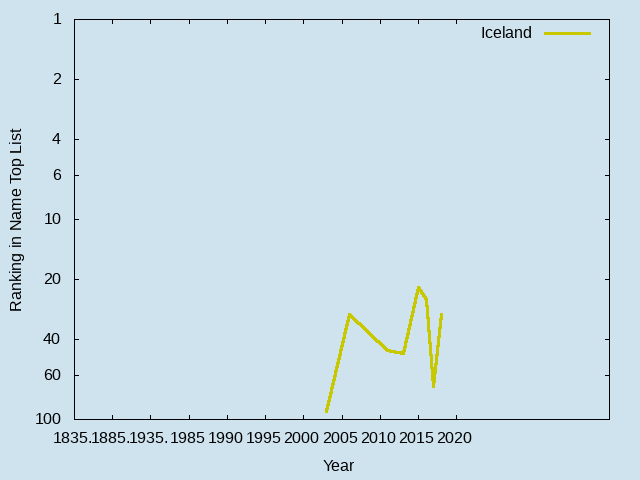 Sources: [19]
References
- ↑ 1.0 1.1 1.2 Roland Otterbjörk: Svenska förnamn (1979)
- ↑ 2.0 2.1 2.2 2.3 Lars Magnar Enoksen: Norrøne guder og myter (2008)
- ↑ 3.0 3.1 3.2 3.3 3.4 Rudolf Simek: Dictionary of Northern Mythology (1993)
- ↑ 4.0 4.1 4.2 Kristoffer Kruken og Ola Stemshaug: Norsk Personnamnleksikon (1995)
- ↑ Árni Dahl: Navnabókin (2005)
- ↑ 6.0 6.1 Eva Brylla: Förnamn i Sverige (2004)
- ↑ 7.0 7.1 Gulbrand Alhaug: 10 001 navn - Norsk fornavnleksikon (2011)
- ↑ Mannanafnaskrá at island.is, http://www.island.is
- ↑ Leiv Heggstad, Finn Hødnebø og Erik Simensen: Norrøn Ordbok (1997)
- ↑ Ferdinand Holthausen: Vergleichendes und Etymologisches Wörterbuch des Altwestnordischen (1948)
- ↑ Lena Peterson: Nordiskt runnamnslexikon (2007)
- ↑ Lena Peterson: Lexikon över urnordiska personnamn (2004)
- ↑ Hagstofa Íslands, National statistics office of Iceland, http://www.hagstofan.is/
- ↑ Danmarks Statistik, National statistics office of Denmark, http://www.dst.dk
- ↑ Statistiska Centralbyrån, National statistics office of Sweden, http://www.scb.se/
- ↑ Statistisk Sentralbyrå, National statistics office of Norway, http://www.ssb.no
- ↑ Väestörekisterikeskus, National Population Register Centre of Finland, http://www.vrk.fi
- ↑ Grønlands Statistik, Statistics office of Greenland, http://www.stat.gl/
- ↑ details see Name Statistic tables